CRM vs. Relationship Intelligence

Every fundraiser knows the feeling: you have a CRM full of data, but you still don't know where to start your week.
You can see every gift, every event attendance, every email open. But when you sit down Monday morning and ask "who needs my attention right now?"—the CRM just stares back at you.
That's not a bug. It's a design constraint.
What your CRM actually does (and does well)
Your CRM is a system of record. It stores contacts, gifts, activities, and communications. It maintains institutional memory: who gave, when, through which channel, for what purpose.
This matters. Without a CRM, you have no foundation.
But a CRM isn't built to answer the questions fundraisers wrestle with daily: Where should I focus first? Who's becoming more engaged? Who's quietly drifting away? What's the right next step with this specific donor?
What Relationship Intelligence adds
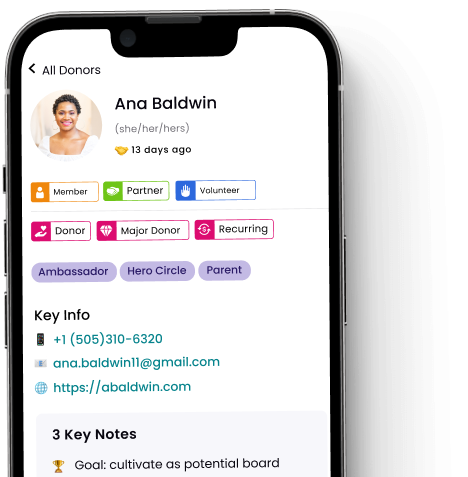
Relationship Intelligence sits on top of your CRM and interprets what's in it. Where your CRM shows you the past, RI suggests what matters now.
The difference looks like this:
CRM - Relationship Intelligence
"I can see what we did."
"I can see what we should do next."
Static records
Dynamic signals and scores
Lists and reports
Prioritized views and prompts
You do the analysis
Analytics surface the patterns
RI weaves together enriched data, engagement patterns, relationship maps, and sentiment signals to answer questions your CRM can't: Which donors are at risk of lapsing? Who's showing signs of upgrade readiness? Where will a well-timed conversation make the biggest difference?
Do you need both?
Short answer: you need a CRM. Whether you need dedicated RI depends on scale and complexity.
A CRM alone may be enough if:
- Your active donor base is under 500
- Your segmentation needs are simple
- You have capacity for manual analysis
- One or two people manage all relationships
You likely need RI capabilities if:
- Your donor base is growing or complex
- Multiple fundraisers manage overlapping relationships
- You're struggling with retention or upgrade rates
- You need to prioritize limited time across many relationships
- You want to catch engagement shifts before they become lapses
How they work together
RI doesn't replace your CRM—it activates it. When integrated well, the two create a feedback loop: clean CRM data fuels better RI models, better models highlight where to reach out, better outreach generates more relevant data that flows back into the CRM.
For fundraisers, the experience shifts. Data entry stops feeling like a chore and starts feeling like a way to keep the relationship picture current and useful.
Your CRM is the foundation. Relationship Intelligence is what makes it actionable.

More of the latest


What Happens in the First 90 Days After a Gift?
The first 90 days after a gift determine whether a donor comes back. Here's how to audit your new donor experience.
Read Blog

The Donor Retention Math
80% of first-time donors never give again. Here's what that actually costs—and what high-retention organizations do differently.
Read Blog

How to Create a Capital Campaign Strategy
Learn how to create a capital campaign strategy from the ground up in this article. Read to get tips on how to build deeper relationships with key donors.
Read Blog